


Note: parts of this article originally appeared in a 2016 piece I wrote for MiddleWeb, “Should We Try to Make History “Relevant?” You can read that piece here.
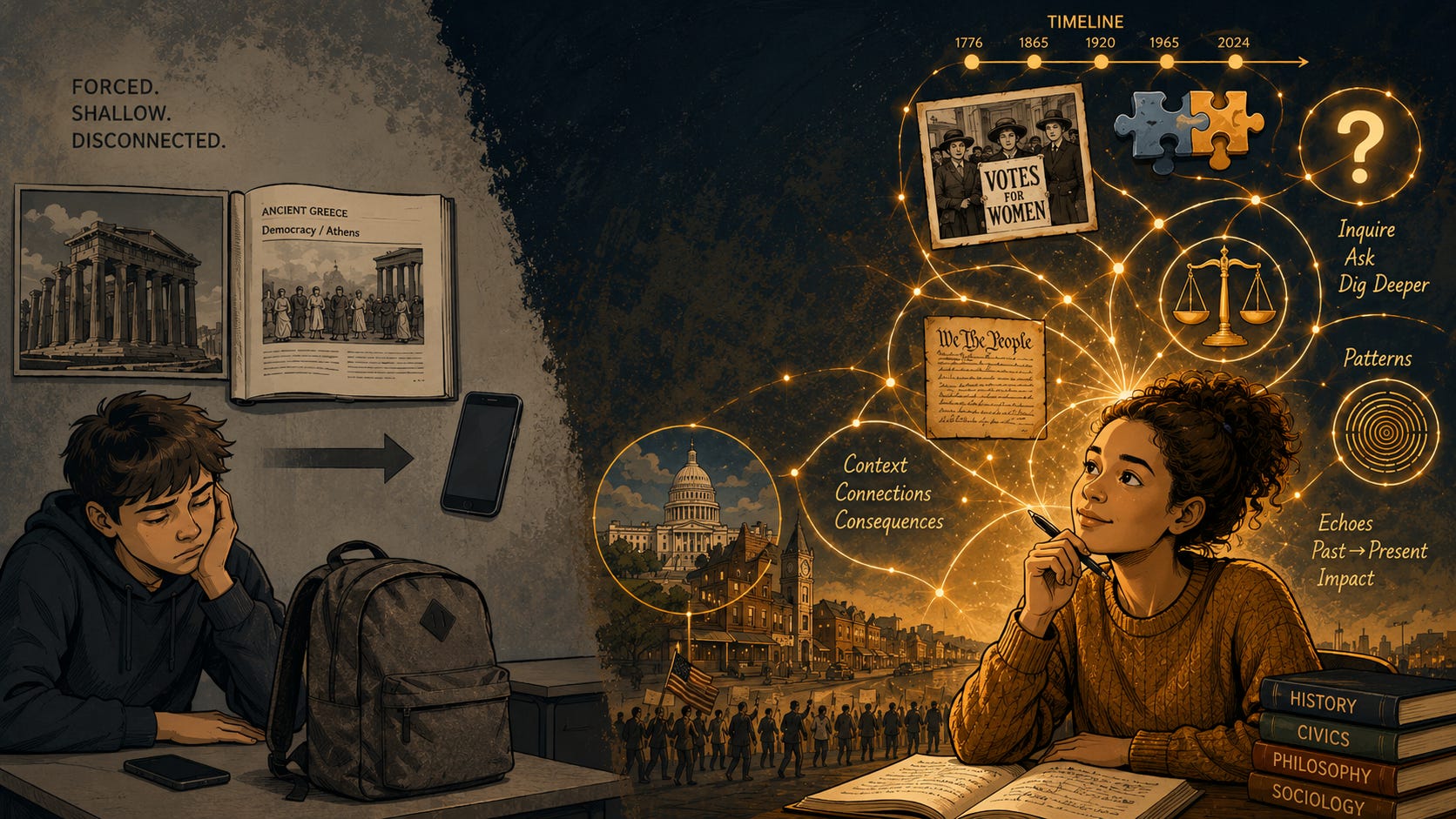
When I worked with student teachers in history, one of the more common phrases I heard was their desire to “make history relevant to my students’ lives.”
I heard it so often, in fact, that it became clichéd.
Most history teachers are aware that our subject is among those most likely to be described as “boring” by students. Search online the words “history and boring” or “why students hate history,” and you will see what I mean.
One reason I hate the phrase, “making history relevant” is the utilitarian bias of it— it suggests that something must be useful to make it worthy of our attention.
Of course, I do think history is useful. But not because it can lead to a job or because you have to know it to get into college or because it teaches critical thinking or anything like that. I have always loved history because I found it beautiful and interesting. I study it because I want to know why things are the way they are, how they came to be. And that makes my life richer.1
Believe it or not, students want to know stuff too. They want to know things about the world they live in because human beings are naturally curious.2
The goal of educating our students is to introduce them to the wider world of which they are a part, to what they don’t already know. Not just connect everything to their lives, which might—because they are children—still be rather closed. Not to mention the fact that what is relevant to one student (sports!) might not be to the student who is more into music.
We can’t and shouldn’t appeal just to what already interests them. The goal is to introduce them to new things they don’t already know. Making history relevant should not mean shrinking the past until it resembles students’ existing experiences. It should mean helping students see why the past is interesting, consequential, puzzling, and connected to the larger world of which they are a part.
The risk of oversimplification
Most importantly, making history “relevant” to students by connecting everything to the present or their own lives risks oversimplifying history. Imagine, for a moment, trying to make your students appreciate what it was like for Jewish families in the late 1930s and early 40s as they tried to escape Nazi oppression. Or what it would be like to leave your home in Seattle during World War II because you were of Japanese ancestry.
Consider the two misguided ideas below:
Ask students to think about a time they moved or went on a trip somewhere.
Think about a time when you felt discriminated against or left out.
Moving to another town because your mom got a new job is not anything like fleeing for your life or being evicted from your home in the middle of the night at gunpoint (or in the daytime because of an Executive Order). And most kids know this.
Even if some students don’t know this, a teacher who asks for this sort of analogy from his or her students risks suggesting that it is an appropriate analogy. The teacher risks minimizing the realities of the historic situation. The teacher risks oversimplifying the history.
More to the point, it really isn’t necessary to relate these historic events to students’ lives. These are among some of the topics that students routinely find the most interesting. In my experience, even students who really dislike history find themselves interested in the Holocaust and the internment of Japanese-Americans.
I think the reason for their interest is that all of these topics deal with a fundamental philosophical issue: justice. And there is nothing that grabs the interest of an adolescent more than justice and the perception that something is unfair.
Adolescents are constantly being told what to do by adults at the same time they’re beginning to feel more independent and capable – and developing opinions of their own. It makes sense that questions about justice or the lack of it would be issues that grab their attention.
Answer the question they’re already asking
Of course, students don’t always leap at the chance to learn something new, in the same way that I’m more interested in ice cream for dessert rather than fresh fruit. But when the fruit is seasonal, cut up attractively and in a bowl, I’m more interested. We can do the same for our students. Take them seriously when they say, “This is boring” and ask them why. They will appreciate that you are taking their complaints seriously.
Address the complaint by telling them why you are teaching what you are teaching. Why do you think it is important, interesting, worth knowing? You’ve got roughly 180 days of teaching in a school year. Of all the hundreds/thousands of topics in history, telling students the reasons you have chosen each of the lesson topics you have chosen will interest them. They have not likely heard this kind of talk from their other teachers.
In their book, The Disengaged Teen: Helping Kids Learn Better, Feel Better, co-authors Jenny Anderson and Rebecca Winthrop mention some studies by psychology professor Johnmarshall Reeve that found kids were more motivated and learned more when students felt like they had agency over their learning.3 One of the examples is taking seriously their comments about boredom and when they ask “why do we have to know this.” Students are ALWAYS asking that question, even when it is subconscious and they are silent. It’s that passivity we need to fight against.
So raising the question yourself and answering it—e.g. why do we need to give a crap about the New Deal is useful in getting their attention, which is the first step in learning. Every question we have in the U.S. about the economy and the extent to which the government regulates it or not relates back to the New Deal. Nearly one out of every four people was unemployed during the Depression. Hitler had an answer to the depression in Germany and F.D.R. came up with a different one. Ask them a big question back: does an unhealthy economy lead to an unhealthy democracy?4 These points show them why this knowledge matters.
Give them something to wonder about
Harness kids vs. adults to your advantage
Tell them you are teaching something most adults don’t know. Kids love when they know something adults don’t know. This is actually pretty easy, sadly, because so many adults “don’t know much about history” (cue the song).
Show them a mistake. In the textbook, in a movie, in a politician’s speech (just don’t make it partisan), in a novel they are reading in English class.
Kids love it when adults screw up. So tell them how you screwed up.
Tell them how you (as a teacher) used to teach this topic in a different way and how and why you changed it. It shows that you have learned more over time and now you recognize the mistake of asking your students to write an essay on “whether or not Truman should have used the atomic bomb” because it encourages ahistorical thinking. As if context didn’t matter. (Which is not to say that I think dropping the bomb on Japan was cool. I’m saying it was complicated and our students deserve to know more before we recklessly ask them to opine.)
Tell them a story.
Cognitive psychologist Daniel Willingham has said that stories are “cognitively privileged,” meaning that we are more likely to remember information if it is presented as a story. All history is a story, but some stories are more interesting than others. A few examples of what often makes stories interesting and ways to hook kids:
give your stories a surprising twist (e.g. how an uprising in Haiti and a bunch of mosquitos led the U.S. to triple in size) - how a war with Spain over Cuba’s freedom led to the colonization of the Philippines.
incredible statistics - the connection between the annihilation of the buffalo and the wars against Native Americans in the west. The number of casualties suffered in World War II by the United States compared to the Soviet Union and how that is one explanation for the beginning of the Cold War.
stories that involve coincidence— like Thomas Jefferson and John Adams dying on the same day that just happened to be the 50th anniversary of the Declaration of Independence. (If it was a movie ending, you’d think it was cheesy.) Or that Frances Perkins, F.D.R.’s Secretary of Labor, happened to be visiting a friend in Washington Square on the day of the Triangle Shirtwaist Fire. She later recalled that the horrors of that day influenced her politics and her push for workers rights.5
Challenge students
Give them work that’s hard, but show them how to get there. Tell your middle schoolers it’s hard, but you are confident they will be able to figure it out. And that the parts they struggle with, don’t feel bad if you do because your high school students struggled with it. Or the first time you read it as an adult you misunderstood it.
Use cognitive dissonance and multiple perspectives— the surprise that in Vietnam, the war is called “The American War.”
Asking questions and solving puzzles
But don’t just tell students that the Vietnamese call it that. Ask them what they think the war is called there. Asking questions that puzzle our students is what piques interest in the first place.
Think about times when someone asks you something— a trivia kind of question for example— and you know the answer but you don’t remember it right away. We often say things like, “Wait! Don’t tell me, I know this…!” It’s because the human brain likes solving puzzles, as long as they’re not too hard. We need to find the sweet spot: asking questions and solving puzzles that are not too easy (boring) or too hard (our brain says no and wants to give up). It’s like Goldilocks. Not too hard, not too soft.
Finding just the right question to ask is worthy of our time. The constant in my classroom was a question of the day on the board, every day. Not an objective or a learning target; students could care less about that. A question that would peak their interest and be answered before the end of the period—sometimes right away at the beginning of the lesson, sometimes in the middle and sometimes not until the end.
Again from Daniel Willingham, in his book Why Students Don’t Like School (talk about a great question that makes you want to check out this book!6):
…thinking is slow, effortful, and uncertain. Nevertheless, we find successful thinking pleasurable. We like solving problems, understanding new ideas, and so forth…. [W]e choose problems that pose some challenge but that seem likely to be solvable, because these are the problems that lead to feelings of pleasure and satisfaction.
….Sometimes I think that we, as teachers, are so eager to get to the answers that we do not devote sufficient time to developing the question…. [I]’ts the question that piques people’s interest. Being told an answer doesn’t do anything for you.
So take the time to think about what in your material is puzzling or thought-provoking and start with that.
Help students discover meaningful connections
Learning is hard, but cognitive science tells us that we are able to learn more when we can connect new information to things we already know. Also, we can make connections that get our students’ attention, which has to happen before any learning can occur. Neuroscience research on insight suggests that these “Aha!” moments engage the brain’s reward system, including regions associated with dopamine signaling. 7
We can give our kids moments like these in a variety of ways.
Connect to an anniversary or birthday. It was so awesome the year that March 4, the old inauguration day, fell on the day that coincided with my introductory lesson on Franklin D. Roosevelt. There’s something about hearing F.D.R. say, “the only thing we have to fear is fear itself” on the anniversary of the day he actually said that. Subscribe to “this day in history” from History.com and you’ll be informed about upcoming anniversaries. I would not do this every day or you’ll overload their working memory, distracting them from the lesson at hand. So use it only when it’s relevant to your current lesson, or connects to a past lesson and you want to use it as a form of retrieval practice to remind students of previously learned material.
Connect it to the histories/families of your students or former students. I know I earlier said to be careful about connecting everything to students. But there is a way to do this that avoids treating their experiences as simplistic analogies for historical experiences that were profoundly different— consider how your students’ pasts are part of history.
I had a student whose great uncle was Senator Glass of the Glass-Steagall Act, countless students whose families were part of the Great Migration, including one whose grandfather was Emmett Till’s first cousin and was in Money, Mississippi the night Till was kidnapped and murdered! I had a student whose grandfather grew up on the same block as Cassius Clay (Mohammed Ali). Another whose grandfather was a bracero, a worker brought in from Mexico during World War II. Another whose great grandmother fought for women’s suffrage. And so on. You do too. You’ll know that if you assign projects where students have to do a family history or something like that. Even if your current students don’t know the student whose great uncle was Senator Glass, knowing that she sat in that seat by the window is kinda cool. It makes it real.
Connect to something local or at least regional. I am lucky that I am in the Chicago area because Chicago and its suburbs and hinterlands are chock full of great stories. But so are lots of other places. Even if you live in a small community in a rural area, there will have been people from that area who fought in a war, experienced the Great Depression, had a bomb shelter put in during the Cold War, has or had immigrants come there during the great wave of immigration in the early 1900s or some other connection. There is likely to be some historic site nearby, and it is historic because it connects to some larger state or national event.
Do you travel? Any time I visit anything historic I get a picture of myself next to the site. I use those photos in my slides. It catches students’ attention because they have a relationship with me. So it’s not just a picture of the courthouse where the Dred Scott case was decided in St. Louis. It’s Ms. Brown in front of the courthouse where the Dred Scott case was decided. It reminds students that these events and places exist in real life.
Connecting to the present. And speaking of real life, surely one of the reasons we study history is to better understand our present. So we can and should make connections to the present. This helps students see that it is not just a story of the past but something that is real in our world today. We must, however, avoid trite or glib connections that obscure profound differences between the past and the present, risking historical presentism.
If you do one thing in these last few weeks of summer to prepare for the coming school year, look at a few of your lessons and ask what might make students genuinely want to know more. You can do that by asking yourself why do you find it interesting? Give them a puzzle, a surprising connection, a compelling story, or a reason the subject matters.
Making history relevant does not require us to reduce the past to something students have already experienced. It requires us to show them that the past is full of questions worth asking, stories worth knowing, and connections worth discovering. The goal is not to make history smaller so that it fits inside students’ existing worlds. It is to use history to make their worlds larger—to help them recognize that the places they live, the questions they argue about, and the society they have inherited are all part of a much longer, more complicated and endlessly fascinating human story.
How do you make history relevant without reducing the past to something students have already experienced? I’d love to hear what has worked in your classroom.
Significantly, the word “history” comes from the Greek root, historia which means“a learning or knowing by inquiry; an account of one’s inquiries; knowledge, account, historical account, record, narrative.” See https://www.etymonline.com/word/history.
See https://pmc.ncbi.nlm.nih.gov/articles/PMC4635443/ and you might also be interested in my piece, Curiosity in the Classroom.
Read more about the book here. I highly recommend it! The pages I refer to about Johnmarshall Reeve’s work are pages 114- 121.
My answer: yes. That is why income inequality that has risen since the 1970s is a key problem. Read an interesting article the other day that mentioned that Elon Musk’s net worth is five million times as large as that of the average American family. The article pointed out that Plato argued that a healthy republic if anyone acquired more than four times the wealth of the poorest citizens, they should donate the surplus to the republic. (See “Elon Musk Confirms Ancient Concerns about the Superrich.” Think about the fact that there were folks that were torn between voting for Donald Trump and Bernie Sanders.
Read this lovely piece by Heather Cox Richardson about Perkins.
Don’t have time to read another book? Check out the article of the same title: “Why Don’t Students Like School?” and “How Knowledge Helps.” But I do highly recommend the whole book. The quotes come from pages 18 and 20 in my 1st edition copy.
Full disclosure: I’m not a cognitive scientist, and I didn’t read either of these two articles. But they do support the argument: Ultra-high-field fMRI insights on insight: Neural correlates of the Aha!-moment and An insight-related neural reward signal. Remember that this Substack is free. I’m not being paid to do this kind of research. 😉
Such pleasure and pride to recall that we once published the first version of this excellent treatise on teaching history in engaging AND meaningful ways...and to read the new version. It's like extra sprinkles on our ice cream. Or attractively arranged fruit.
Thanks for writing such an important reminder on the importance and dignity of teaching history. For 17 years I’ve tried to keep present in my mind most of these tenets you write about. I think they’ve helped me reach many a reluctant student but you also provided insights that I hadn’t thought about much.